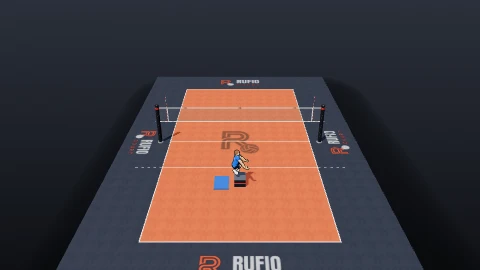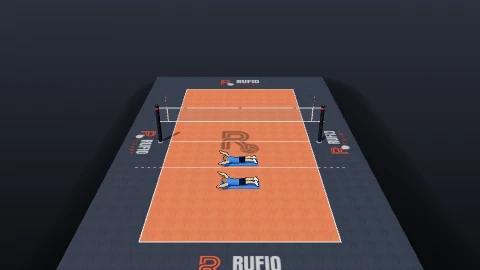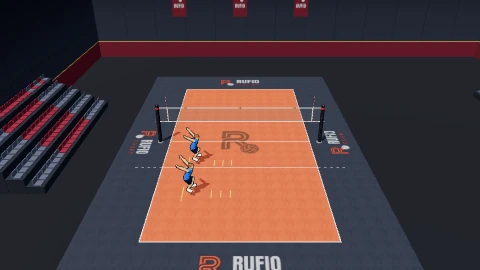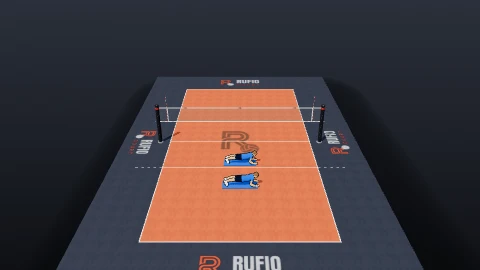
Med-ball rotation throw
Strength drill for 2 to 10 players. Focus: power from the hips; a balanced, explosive release.
What you need
- Players
- 2 to 10 players
- Time
- 5 to 8 min
- Level
- Intermediate
- Equipment
- Med ball
- Ball fed by
- The players
- Space
- Half a court
Setup
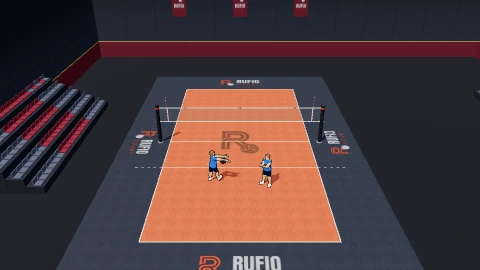
- Pairs stand side by side about 3 m (10 ft) apart, facing opposite ways, so each partner is on the other's throwing side.
- One 2 to 4 kg medicine ball per pair; a softer ball that does not bounce is best.
- Swap places after each set to work the other side.
How it runs
Partners stand sideways to each other about 3 m (10 ft) apart with one medicine ball. The thrower turns away to load the ball at the back hip, then drives the hips around and releases it across the body to the partner, who catches it at the chest, loads and throws it straight back. It builds the hip-to-shoulder rotation behind a hard arm swing.
Time and reps: 3 sets of 8 throws per side with a 2 to 4 kg ball, about 60 s rest between sets.
Coaching points
- Load the ball at the back hip with the knees bent and the chest over the feet.
- Turn the hips first, then the chest, then let the arms whip the ball through.
- Release across the body with long arms, and finish facing your partner.
- Catch at the chest with soft arms and go straight into the next load.
Ways to change it
- Throw against a solid wall and catch the rebound.
- Take a step toward the target as you throw.
- Kneel on one knee to keep the work in the trunk.
Terms on this page
- Rotation
- The order players move through the six zones. A team moves one spot clockwise each time it wins the serve back, and the player who moves into zone 1 serves.
Safety
Sets, loads and rest times are suggestions, not medical advice. Check with an athletic trainer or doctor before power training with a medicine ball, especially with youth athletes, and stop if anything hurts.
- Start with a light ball and build up only while the turn stays smooth.
- Rotate through the hips; do not twist hard from the lower back.
- Keep the area clear and throw only when your partner is ready.